

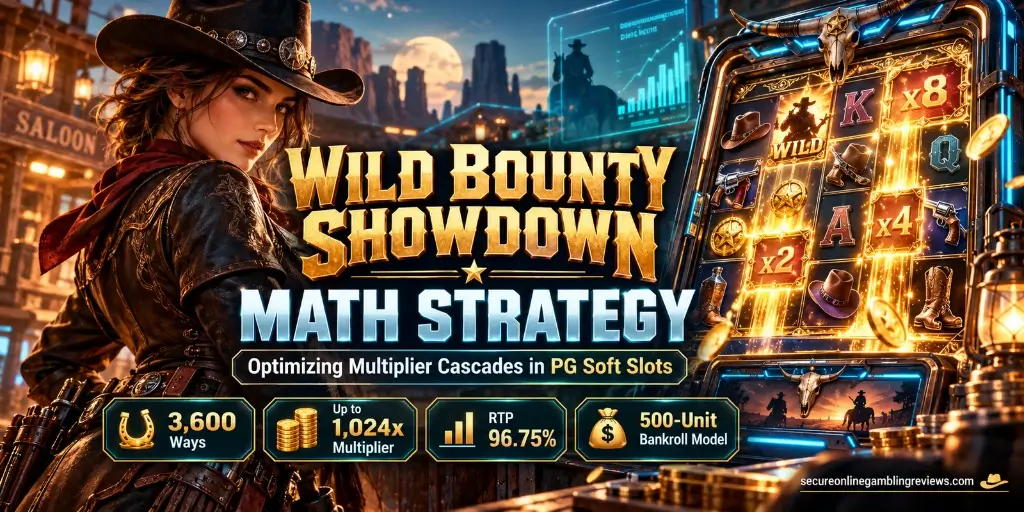
Wild Bounty Showdown Math Strategy: Optimizing Multiplier Cascades in PG Soft Slots
Behind the high-energy Western audio tracks and sleek portrait-first interface of PG Soft’s Wild Bounty Showdown lies one of the most aggressive, mathematically dense multiplier engines in modern mobile gaming. While casual players see a stylish cowboy slot with gold-framed wild conversions, casino insiders and advantage players view the title as an exercise in exponential multiplier progression and volumetric line variance.
To successfully navigate PG Soft’s release, players must look beyond aesthetic animations. Executing a viable wild bounty showdown slot ev strategy requires a rigorous understanding of how its 3,600 bet ways intersect with cascading mechanics. By deconstructing the mathematical framework of the game’s doubling multiplier engine, players can optimize their bet sizing, manage capital drawdowns, and maximize Expected Value (EV) during favorable session waves.
1. Reel Architecture & Mathematical Mechanics
Unlike standard $5 \times 3$ or $5 \times 4$ video slots, Wild Bounty Showdown utilizes a distinctive 3-4-5-5-4-3 diamond reel layout. This geometric structure directly governs how paylines are calculated across its cascading reel engine, shaping the overall wild bounty showdown volatility profile.
Core Statistical Parameters
- Theoretical Return to Player (RTP): $96.75\%$
- Engine Volatility Profile: High Variance
- Base Bet Ways: $3,600$ Active Combinations
- Maximum Multiplier Cap: $1,024\times$ Total Multiplier Ceiling
- Base Game Starting Multiplier: $1\times$ (Doubles on every successful cascade step: $1\times \rightarrow 2\times \rightarrow 4\times \rightarrow 8\times \rightarrow 16\times \dots \text{up to } 1,024\times$)
- Maximum Win Cap: $5,000\times$ Total Stake
The 3,600-way framework creates a double-edged mathematical dynamic. Because symbol density expands toward the middle reels (Reels 3 and 4), the game offers a high baseline probability of forming early connection combinations on Reels 1 through 3. However, the engine severely chokes payline pathways across Reels 5 and 6, where position capacity shrinks back down to 3 symbols.
As a result, the Random Number Generator (RNG) frequently delivers small “teaser” connections ($0.2\times$ to $0.8\times$ stake) on early reels. These early tumble steps advance the multiplier engine, but often collapse before high-value symbols can reach Reel 6 to collect the compounded multiplier value.
2. The Exponential Multiplier Cascade Engine
The core engine driving long-term Expected Value in Wild Bounty Showdown is its doubling multiplier system. Mastering pg soft multiplier cascade math requires recognizing the difference between linear progression slots (which add $+1\times$ or $+2\times$ per cascade) and exponential progression engines ($2^n$ progression).
Exponential Active Multiplier Formula:
Active Multiplier $(M_n) = M_0 \times 2^n$
Where $M_0$ represents the base multiplier floor ($1\times$ in Base Game, $8\times$ in Free Spins), and $n$ represents the number of consecutive winning cascades within a single spin cycle.
The Mathematical Shift in Free Spins
The true EV escalation occurs when landing 3 Scatter symbols to trigger 10 Free Spins. During the Free Spins feature, the initial multiplier floor permanently shifts from $1\times$ to $8\times$.
Crucially, during Free Spins, any non-winning tumble resets the active multiplier back to the elevated $8\times$ floor, rather than resetting to $1\times$. This floor shift drastically alters the statistical payoff distribution:
Because the base multiplier during Free Spins starts at $8\times$, even modest low-tier symbol payouts on early cascade steps instantly clear the threshold for net-positive returns ($\ge 1.0\times$ total stake). This eliminates the bankroll erosion typically caused by losses disguised as wins (LDWs) during standard play.

3. Gold-Framed Symbols & Payout Probability
A second core engine component critical to modeling variance is the Gold-Framed Symbol Conversion system. Evaluating gold framed symbols payout probability is essential for avoiding common psychological traps.
During any base spin or tumble, random non-wild symbols appearing on Reels 3 and 4 may feature a gold border. When a gold-framed symbol participates in a winning payline, it does not dissolve during the cascade. Instead, it transforms into a Wild Symbol for the subsequent drop.
The Mathematical Trap of Gold Frames
Inexperienced players often overvalue gold-framed symbols on Reels 3 and 4 while ignoring symbol alignment on Reels 1 and 2. Mathematically, a gold-framed symbol on Reel 3 or 4 holds zero financial value unless Reels 1 and 2 land matching base symbols on that precise spin microsecond.
4. Bankroll Sizing & Risk of Ruin Math
Because Wild Bounty Showdown allocates over $65\%$ of its total RTP budget into high-cascade chains and the Free Spins Feature, its base game exhibits severe variance troughs. Without adequate capital management, player bankrolls face high Risk of Ruin during cold cycles.
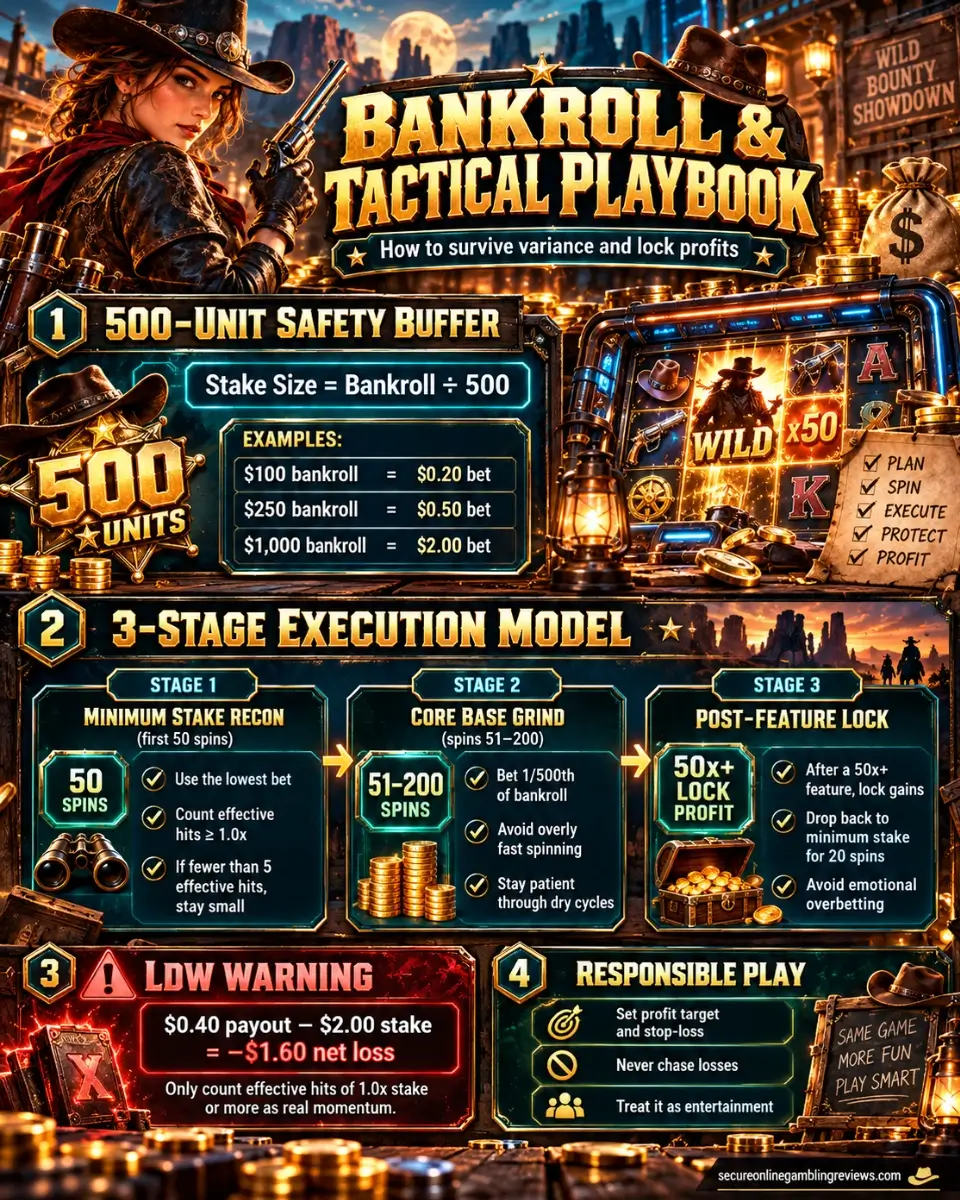
To establish a sustainable 500-unit bankroll sizing model, calculate your maximum base bet ($S$) relative to your total session budget ($B$):
Base Bet Sizing Formula:
Base Stake $(S) = \frac{\text{Total Bankroll } (B)}{500 \text{ Units}}$
Example: With a total session bankroll of $250.00, your max stake per spin should be: $\frac{\$250.00}{500} = \$0.50$ per spin.
| Total Session Capital ($B$) | Base Bet Size ($S$) | Spin Reserve Capacity | 50% Drawdown Safety Mark |
|---|---|---|---|
| $100.00 | $0.20 per spin | 500 Total Spins | -$50.00 (250 Spins Reserve) |
| $250.00 | $0.50 per spin | 500 Total Spins | -$125.00 (250 Spins Reserve) |
| $500.00 | $1.00 per spin | 500 Total Spins | -$250.00 (250 Spins Reserve) |
| $1,000.00 | $2.00 per spin | 500 Total Spins | -$500.00 (250 Spins Reserve) |
Maintaining a 500-unit buffer provides a $99.2\%$ statistical buffer against total liquidation during a 35-spin dead-spin cycle. It also grants sufficient spin capacity to reach the statistically estimated $150 \text{ to } 220$ spin window needed to trigger the Free Spins Feature.
5. Tactical Execution Playbook for Advantage Players
To play Wild Bounty Showdown with maximum mathematical discipline, execute this 3-stage tactical framework:
Stage 1: Minimum Bet Reconnaissance (Spins 1–50)
- Set your wager to the absolute minimum bet allowed by the casino.
- Record the number of Effective Hits ($\ge 1.0\times$ total stake) over 50 spins.
- Decision Protocol: If Effective Hit Frequency is under $10\%$ (fewer than 5 net-positive spins out of 50), the machine is in a deep base game variance trough. Maintain minimum wagers or temporarily switch games.
Stage 2: Core Base Grind (Spins 51–200)
- Scale your bet size to exactly $1/500\text{th}$ of your current bankroll.
- Avoid using turbo-spin features. Fast spinning increases spin velocity per minute, accelerating balance depletion during low-payout cycles.
- Monitor Scatter frequency. Landing two Scatter symbols (“teases”) confirms that the engine is cycling through core symbol distributions.
Stage 3: Post-Bonus Profit Lock
- When a Free Spins round triggers and yields a net win $\ge 50\times$ your base bet, lock in your profits immediately.
- Reduce bet size back to Stage 1 levels for 20 spins to navigate the post-feature cold cycle without sacrificing acquired gains.
6. Summary & Responsible Gaming Standards
Wild Bounty Showdown’s 3,600 bet ways and $1,024\times$ exponential multiplier engine make it one of PG Soft’s most mathematically dynamic slots. However, no betting strategy can bypass the inherent house edge ($3.25\%$) over an infinite sample size. Use bankroll modeling and structured exit strategies to maintain full session control, set deposit limits, and gamble responsibly.