

The Reel Cycle Secret: How Slot Volatility Waves Dictate Your Session Strategy
- The Anatomy of a Slot Engine: Beyond the Flashing Lights
- The Multiplier Trap: Losses Disguised as Wins
- Navigating Variance Cycles: The 3-Stage Session Strategy
- Game Engine Comparison: Finding Your Playing Style
- Bankroll Survival: The 500-Unit Safety Net
- Smart Casino Play & Responsible Gaming
- Frequently Asked Questions
If you have spent any real time spinning video slots online, you know the feeling. One moment, a slot machine feels completely frozen—devouring twenty consecutive bets without yielding a single winning line. The next, the reels suddenly ignite, triggering back-to-back bonus features, wild multipliers, and screen-clearing connections.
Casual players attribute these dramatic shifts to “luck” or “hot and cold streaks.” Professional slot enthusiasts and casino insiders, however, know better. What you are experiencing is the mechanical heartbeat of modern slot engines: Volatility Waves and Variance Cycles.
Understanding how developers structure these cycles isn’t about outsmarting an unbreakable Random Number Generator (RNG). It’s about learning how to navigate the waves, manage your balance through the dry spells, and capitalize when the game’s mathematical engine enters a high-payout distribution phase.
The Anatomy of a Slot Engine: Beyond the Flashing Lights
Every licensed online slot operates on a certified Random Number Generator (RNG). This cryptographic software generates thousands of random numbers every single millisecond. The exact microsecond you tap the “SPIN” button, the engine selects an outcome, rendering the animation on your screen as pure visual theater.
However, an RNG does not mean every outcome is weighted equally on every spin. Developers design slot games with a specific Volatility Profile that dictates how payouts are distributed over time:
- High-Volatility Slot Profile: Payouts are compressed into massive, rare events (Bonus Rounds, Free Spins, Multiplier Clusters). The base game is intentionally sparse, meaning long stretches of zero or low payouts.
- Low-Volatility Slot Profile: Payouts are fragmented into frequent, small connections. The engine provides constant session feedback, but mega-payouts are mathematically capped.
The Multiplier Trap: Losses Disguised as Wins
One of the most important metrics to master when analyzing online slots is separating real hits from Losses Disguised as Wins (LDWs).
When you bet $2.00 per spin and the reels line up to pay $0.40, the slot machine celebrates with upbeat sounds and flashing gold coins. Your brain registers a win, but your balance drops by -$1.60.
Actual Financial Impact Formula:
Payout Received – Total Stake = Net Result
$0.40 (Win) – $2.00 (Stake) = -$1.60 (Net Loss)

Why Developers Use LDWs
- Dopamine Retention: LDWs keep players engaged by simulating winning frequency and triggering psychological reward loops.
- Hit Frequency Inflation: A game can boast a “30% Hit Frequency,” but if 20% of those hits are LDWs, your bankroll will decay much faster than expected.
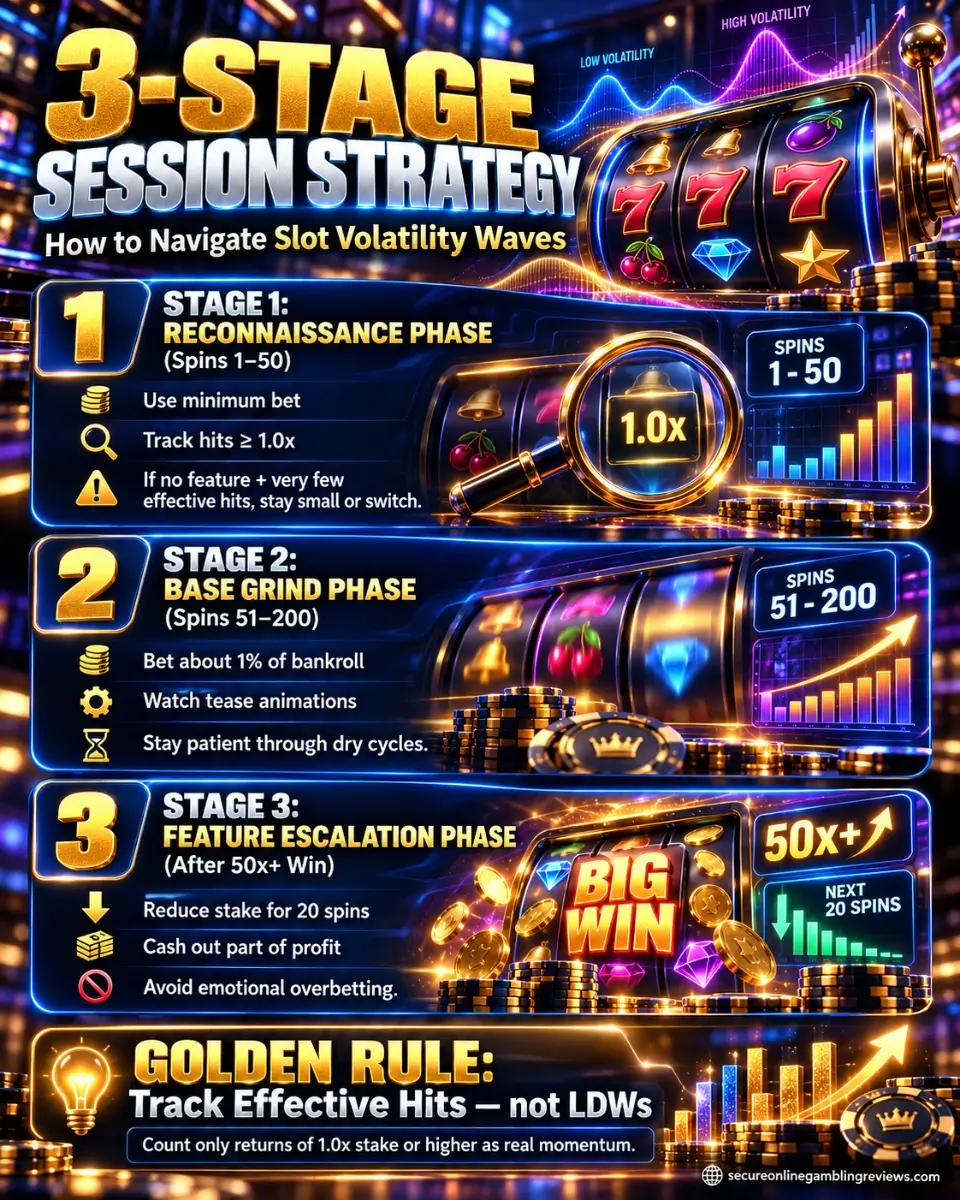
Navigating Variance Cycles: The 3-Stage Session Strategy
To survive high-volatility online slots and position yourself for major feature triggers, you need a structured approach to your session. Here is the 3-stage tactical playbook used by experienced casino players:
Stage 1: The Reconnaissance Phase (Spins 1–50)
- Goal: Gauge the game’s Effective Hit Frequency without exposing heavy capital.
- Action: Set your stake to the absolute minimum bet allowed. Track how many times out of 50 spins the machine returns ≥ 1.0x your wager.
- Decision Check: If the game yields zero features and fewer than 5 effective hits in 50 spins, the engine is currently in a deep variance trough. Maintain minimum stakes or switch titles.
Stage 2: The Base Grind Phase (Spins 51–200)
- Goal: Maintain session momentum while waiting for the statistical trigger window.
- Action: Scale your bet to 1% of your total session bankroll (e.g., $1.00 bets on a $100 bankroll).
- Key Metric: Watch for “Tease Animations” (e.g., landing 2 out of 3 Scatter symbols). While scatters are random, high-frequency teases indicate you are actively cycling through the game’s core symbol distributions.
Stage 3: The Feature Escalation Phase (Post-Trigger)
- Goal: Protect your profits immediately after a major payout.
- Action: The moment you hit a major Bonus Round or a win exceeding 50x your stake, lock in your gains. Drop your bet size back to Stage 1 levels for 20 spins or cash out a portion of your winnings.
- The Psychology: The biggest mistake online casino players make is instantly increasing their stake after a big win, giving back their entire profit during the inevitable post-bonus cold cycle.
Game Engine Comparison: Finding Your Playing Style
Not all online slots are built the same. Here is how three iconic game mechanics compare in terms of risk, reward, and session dynamics:
| Engine / Mechanic | Example Title | Volatility Level | Best Used For |
|---|---|---|---|
| Both-Ways Pay Lines | Starburst | Low | Clearing Casino Bonuses & Turnover |
| Tumble / Pay-Anywhere | Gates of Olympus | High / Extreme | Big Multiplier Hunting & Cascades |
| Cluster Pays Engine | Sweet Bonanza | Medium-High | Balanced Session Length & Symbol Blocks |
- Both-Ways Pay Engines: These slots calculate winning lines from left-to-right AND right-to-left. They offer low volatility and high effective hit rates, making them ideal for converting bonus turnover requirements into cashable profits.
- Tumble & Multiplier Engines: Winning symbols disappear, allowing new symbols to fall in a single spin. While base game payouts are low, a single tumbling cascade combined with multiplier symbols can result in 1,000x+ returns in seconds.
Bankroll Survival: The 500-Unit Safety Net
If you want to play high-volatility slots without getting wiped out, your bankroll must match the game’s mathematical variance.
Recommended Session Bankroll Formula:
Base Bet Size x 500 Units = Required Bankroll
Example: If your target bet size is $0.50 per spin: $0.50 x 500 = $250.00 Total Session Bankroll
Having a 500-unit cushion ensures that you can withstand a 30-spin “dead spot” without exhausting your capital before the game’s high-paying bonus features trigger.
Smart Casino Play & Responsible Gaming
Playing online slots should always be an exhilarating form of entertainment, not a financial stressor. The math behind casino slots ensures the house holds an edge over millions of spins. By understanding volatility waves, avoiding the LDW trap, and keeping a strict 500-unit bankroll limit, you take full control of your gaming session.
Always set deposit limits before logging into your casino account, never chase losses during a cold cycle, and know when to hit the cash-out button when the reels pay off!