


Mega Moolah is the name every Singapore and Indonesia player recognizes the second a casino lobby loads — it’s the slot behind online gambling’s most documented record payouts, including a verified €19,430,723.60 win on Absolootly Mad: Mega Moolah in April 2021, still the largest confirmed payout across the entire network. What most players don’t clock is the price tag baked into chasing it: Mega Moolah’s combined RTP sits at 88.12%, with the jackpot pool contribution adding roughly 5.3 percentage points on top, bringing the game’s total theoretical return closer to 93.42% once you count the jackpot chance itself.
Our team pulled RTP breakdowns and payout-cycle data across the major network progressives available on Singapore and Indonesia-facing platforms — Mega Moolah, Mega Fortune, Hall of Gods, and Pragmatic Play’s tiered Jackpot Play titles — to work out when that RTP trade-off is actually justified by the jackpot’s current size, and when you’re just donating to a pool that isn’t due for months.
Why Network Progressives Sacrifice So Much Base RTP
A standalone or local jackpot slot, like the tiered systems on Malaysian APK platforms, usually only shaves 1-5% off base RTP to feed the pool. Network progressives operate differently. Because thousands of players across dozens of casinos are all feeding into one shared SGD or global pool, the studio needs a much larger cut to fund life-changing jackpot sizes.
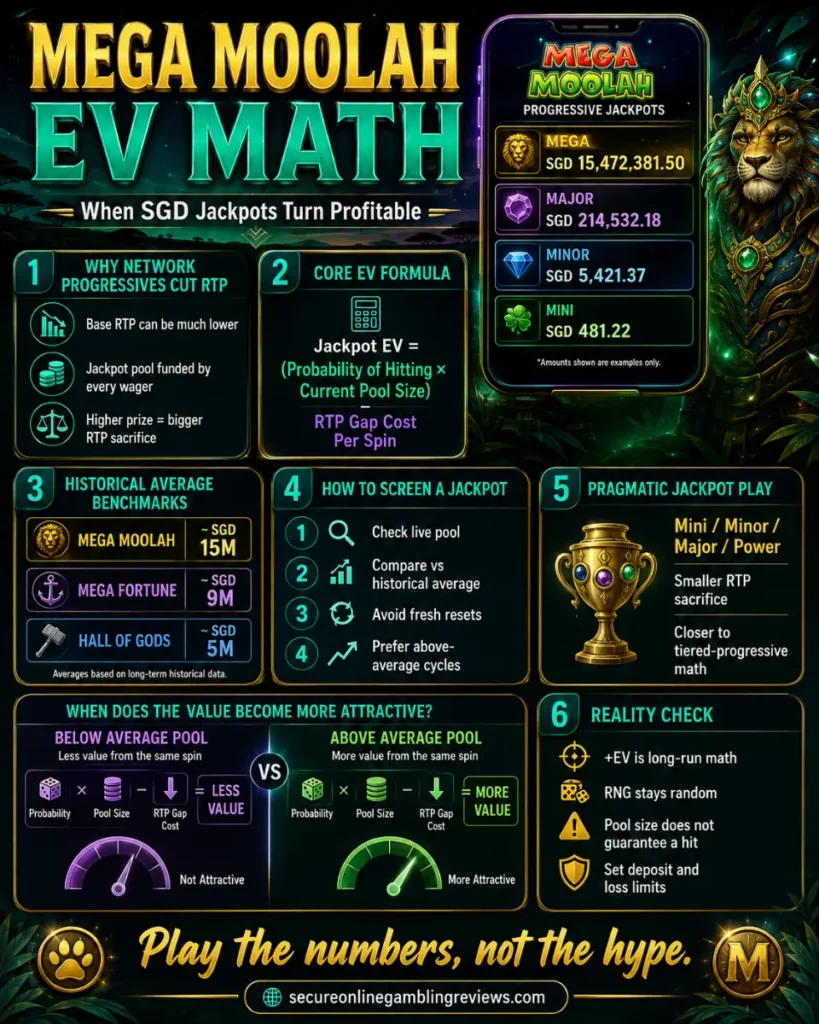
That’s exactly why Mega Moolah’s overall RTP lands around 88-93% depending on how the jackpot slice is counted, well below a typical slot’s 95-97%. Mega Fortune by NetEnt and Hall of Gods run similarly aggressive structures, both consistently appearing on Singapore casino lists precisely because of jackpot size rather than base game return. You are quite literally trading base-game win frequency for a shot at the network pool, and the math only works out if the pool is large enough to offset that gap.
The EV Formula for Network Jackpots
The core formula doesn’t change from any other jackpot type:
Jackpot EV = (probability of hitting) × (current pool size) − (RTP gap cost per spin)
The difference with network progressives is how you estimate hit probability. Unlike a must-hit-by tier with a known ceiling, Mega Moolah’s Mega jackpot pays out on a true random trigger, independent of pool size, and documented history shows it landing roughly every 4-6 weeks across the entire linked network, with an average payout historically cited around £6 million per hit. That means the “probability of hitting” side of the formula stays roughly constant regardless of how big the number looks — the lever that actually moves is the current pool size relative to its own historical average.
Verified network data puts Mega Moolah’s average Mega jackpot win around €5.2-6.7 million, with the documented record at €19.43 million (2021) and the Guinness-recognized record at £13,213,838.68 (2015). Mega Fortune trails with an average payout near £5-7 million roughly every 70 days, and Hall of Gods averages closer to £5 million per hit. Our team’s read on this data: once a network jackpot pushes meaningfully above its own historical average — not the flashy “current” number on the lobby screen, but above where it typically resets and pays — the RTP gap becomes easier to justify, because the payout side of the formula has grown while the trigger probability hasn’t changed. Below that historical average, you’re paying a real RTP tax for a below-average shot at the pool.
Pragmatic Play’s Jackpot Play: A Middle Ground Worth Knowing
Not every jackpot title on Singapore and Indonesia platforms runs the same math as Mega Moolah. Pragmatic Play’s Jackpot Play system, active on titles like Wolf Gold, Kingdom of Atlantis, and Tropical Pop, uses a four-tier community structure — Mini, Minor, Major, and Power — closer in design to the standalone tiers on Malaysian apps than to a pure network progressive.
This matters because Jackpot Play titles typically carry a smaller RTP sacrifice than Mega Moolah’s network structure, while still offering tiered payouts. For players in Indonesia where Pragmatic Play is by far the most searched and played provider on local slot platforms, Jackpot Play titles are worth treating as a separate EV category entirely — closer to the must-hit-by math used on standalone progressives than to the deeper RTP-sacrifice math behind Mega Moolah’s global network.
Reading Pool Size Against Historical Average
Practically, here’s how our team screens these before playing: pull the current jackpot display for Mega Moolah, Mega Fortune, or Hall of Gods, then compare it against the publicly documented historical average for that specific title — roughly €5.2-6.7 million for Mega Moolah, £5-7 million for Mega Fortune, and £5 million for Hall of Gods. If the live number sits meaningfully below that average, the pool likely just reset recently and you’re early in a long cycle — the RTP gap isn’t compensated for yet. If it’s pushing well past the historical average, more player contributions have accumulated than a typical cycle carries, which tightens the gap between the RTP cost and the expected payout.
This isn’t a guarantee mechanism. Mega Moolah’s trigger is still fully random per the game’s certified RNG, and pool size doesn’t change the odds of any individual spin hitting the bonus wheel. What it does give you is a consistent way to avoid sitting on an 88-93% RTP game during the least favorable part of its cycle.
To maximize your mathematical edge across every facet of the iGaming landscape, explore our comprehensive Advanced Betting Strategies hub. Whether you are analyzing line movements in sports betting, minimizing the house edge in live casino table games, calculating expected value (EV) in slots, or exploiting algorithms in arcade games, our data-driven frameworks provide the exact tools you need to consistently outsmart the house.
Responsible Play Note
EV calculations describe long-run probability across many attempts, not a guaranteed result in any single session, and network jackpot RNGs remain fully random regardless of pool size or timing. Set a deposit and loss limit before chasing any jackpot title, treat these as entertainment with a calculated cost, and use your platform’s responsible gambling tools if play stops feeling within your control.