

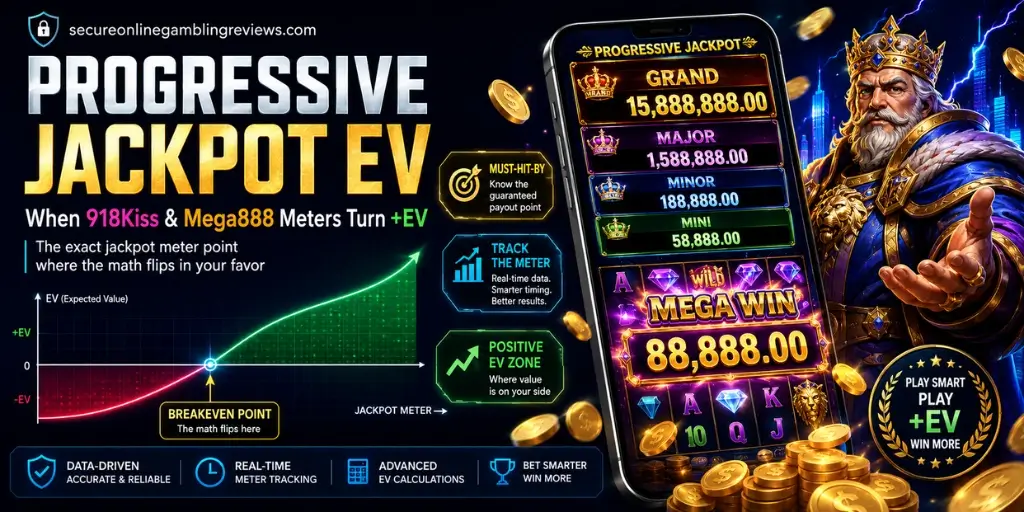
Walk into any 918Kiss or Mega888 lobby and you’ll see four jackpot tiers stacked on the screen — Mini, Minor, Major, and Grand — each climbing at a different pace. Most players just watch the numbers grow and hope. Our team spent several weeks tracking meter resets and payout cycles across both platforms, and the pattern confirms something advantage players in the US and UK have known for years: these jackpots are only worth chasing at a specific, calculable point on the meter — not just when the number looks big.
This guide breaks down the actual EV formula behind Mini/Minor/Major/Grand jackpot tiers, using the RM ranges and cycle behavior our team observed, so you can tell the difference between a jackpot worth sitting down for and one that’s still bleeding your bankroll.
How 918Kiss and Mega888 Structure Their Jackpot Tiers
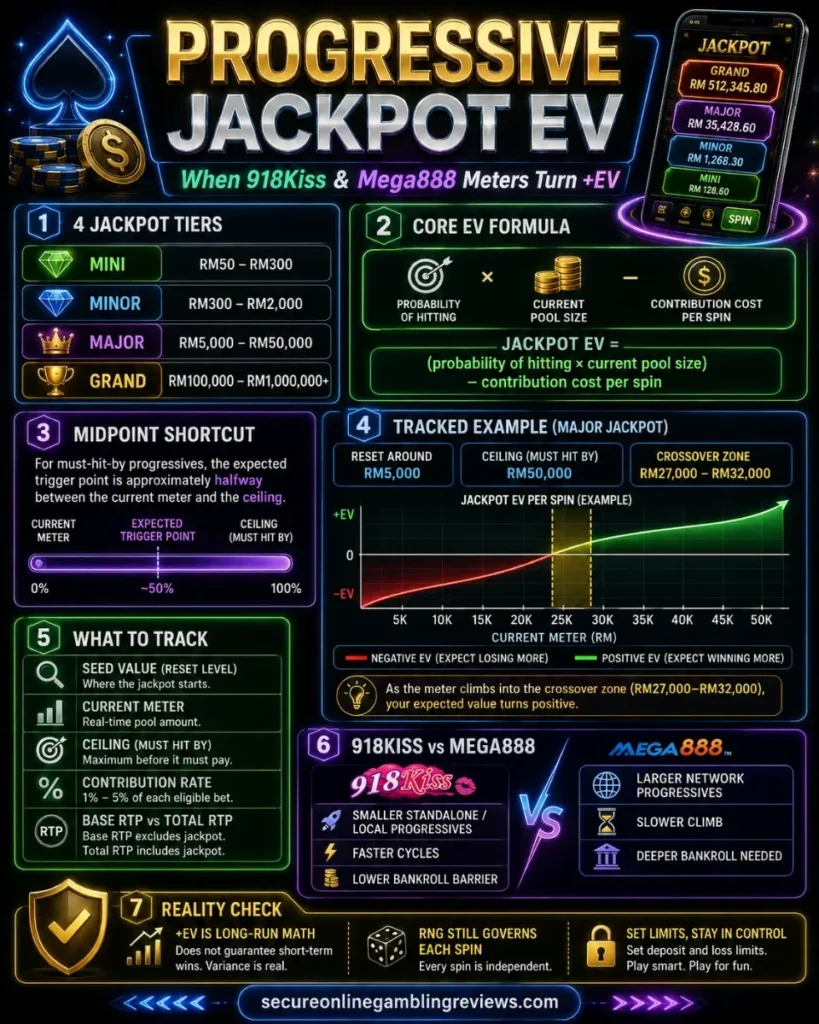
Unlike Western slots that usually run one or two progressive levels, 918Kiss and Mega888 typically split jackpots into four tiers, and each one resets and grows differently:
- Mini Jackpot: roughly RM50–RM300, drops most frequently
- Minor Jackpot: roughly RM300–RM2,000
- Major Jackpot: roughly RM5,000–RM50,000
- Grand Jackpot: RM100,000 up to RM1,000,000+ on titles like Great Blue and Highway Kings
918Kiss’s flagship title, Great Blue, has reportedly paid out RM100,000+ single jackpots over 200 documented times, making it one of the most consistently tracked progressive slots in the Malaysian market.
Mega888 runs a similar structure but tends to push Grand Jackpot ceilings higher during seasonal promotions, at the cost of running a steeper house edge on those specific titles
The key detail most players miss: these are almost always must-hit-by (MHB) style progressives, not open-ended ones. Community-reported data on Malaysian platforms suggests random jackpots on titles like SCR888 tend to drop within specific RM bands — for example, one commonly cited range has minor jackpots dropping between RM1,400–RM3,000, while the same tier rarely runs past RM10,000–RM17,000 before triggering. That ceiling behavior is exactly what makes the EV formula usable.
The EV Formula: What Our Team Tracked
The standard progressive jackpot EV formula is:
Jackpot EV = (probability of hitting) × (current pool size) − (contribution cost per spin)
For a must-hit-by structure, the practical shortcut is the midpoint method: your expected trigger point sits roughly halfway between the current meter reading and the tier’s known ceiling. Below that midpoint, you’re still playing standard negative EV. Once the meter pushes past it, the added jackpot value starts to outweigh the base game’s house edge.
Applying this to a Major Jackpot with a rough ceiling of RM50,000: if our tracked data shows the tier resets around RM5,000 and historically triggers before RM50,000, the crossover point where EV turns positive typically lands somewhere in the RM27,000–RM32,000 range, depending on how aggressive that specific title’s contribution rate is. That’s the number worth checking before you sit down, not the seed value and not the advertised ceiling alone.
Contribution rates on 918Kiss and Mega888 titles generally run 1–5% of every wager into the pool, consistent with standard industry progressive structures.
A title with a faster contribution rate reaches its ceiling — and its positive-EV zone — much quicker than a slow-building one, which is why two jackpot slots showing the same RM number on screen can sit in completely different EV positions.
Before committing a significant portion of your bankroll to a premium bonus round, it is crucial to understand the underlying mathematics. Explore our detailed Slot Feature Buy EV Calculation : A Complete Mathematical Review to learn how to measure the true Expected Value and determine if the upfront cost is statistically justified for your session.
Reading the Meter Before You Play
Our team’s approach when scanning a 918Kiss or Mega888 lobby is simple: check the current jackpot display, compare it against known historical trigger ranges for that specific tier and title, and only treat the machine as a real opportunity once the meter has pushed noticeably past the midpoint of its typical range.
For example, if Great Blue’s Grand Jackpot on your app is sitting at RM180,000 and historical drops on that title cluster between RM150,000 and RM400,000+, you’re still in the lower half of the range — not yet the point where the math favors you. If it’s pushing RM320,000 and drops have consistently landed before RM400,000 historically, that’s a meaningfully stronger position.
This is directional, not guaranteed. Random Number Generators still govern every spin, and no formula overrides the RNG on an individual attempt.
What the EV calculation gives you is a way to compare opportunities across machines and tiers, so you’re not equally likely to sit down at a Mini Jackpot reset at RM60 as you are at a Grand Jackpot pushing its historical ceiling.
Standalone vs Network Progressives: Why It Changes the Math
918Kiss jackpots tend to run as standalone or local progressives — tied to a single machine or a small cluster within one operator — which means smaller ceilings but faster, more frequent cycles. Mega888 sometimes runs wider network progressives during promotional periods, pooling contributions across more machines for a bigger ceiling, but with a longer, slower climb to the positive-EV zone.
If you’re bankroll-limited, standalone tiers on 918Kiss are generally the more practical target — the RM ranges are smaller, the cycles are faster, and you don’t need to survive as long a grind waiting for the crossover point. Network progressives on Mega888 can offer a bigger prize, but the wait for a genuinely positive-EV meter reading is longer and demands a deeper bankroll to sit through.
Recommended Reading
Responsible Play Note
Jackpot EV math describes long-run probability, not a guaranteed outcome on any single session — RNG outcomes remain random regardless of meter position. Always set a deposit and loss limit before you play, treat jackpot hunting as entertainment with calculated risk rather than guaranteed income, and use your platform’s responsible gambling tools if play ever stops feeling in your control.