

Relying on “intuition” or “gut feeling” when playing crash games like Aviator or Spaceman is a guaranteed path to financial ruin. Over 90% of players drain their bankrolls not because the game is rigged, but because they allow dopamine and greed to dictate their exit points. The reality that casinos prefer to keep quiet is that these titles operate on rigid mathematical equations. The only way to survive and extract value is by weaponizing crash gambling math against the algorithm itself.
This breakdown dismantles the Provably Fair architecture and reveals why deploying an auto cashout hack at the exact 1.5x multiplier is the statistical sweet spot. It is time to transition from gambling on luck to executing a data-driven investment.
The Mathematical Reality of Crash Algorithms
Before attempting to exploit the system, you must understand that the trajectory of the multiplier is predetermined before the plane even takes off. A standard crash game algorithm utilizes a Provably Fair cryptographic hash, combining a server seed with client seeds to generate the final outcome.
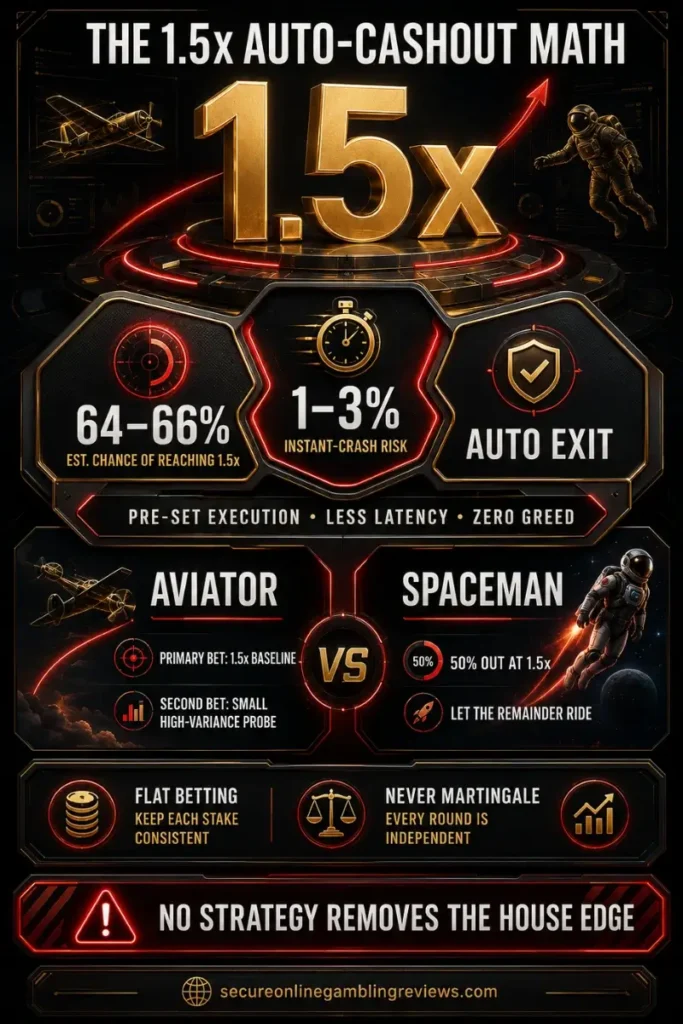
The casino does not manually push a button to crash the graph when a large volume of bets is placed. Instead, the inherent house edge is mathematically embedded in the “Instant Crash”—an event where the graph explodes at exactly 1.00x, giving players zero milliseconds to react. This instant loss occurs in approximately 1% to 3% of all rounds. Consequently, any popular aviator game trick that advises waiting for massive 10x or 50x multipliers is statistically doomed over a large sample size.
Why the 1.5x Auto-Cashout Hack Works
Consistent profitability does not come from superhuman reflexes; it comes from entirely removing human emotion from the equation. Setting a rigid auto cashout hack at 1.5x is a strategy grounded in Expected Value (EV), designed to perfectly balance hit frequency with sustainable payouts.
- Bypassing Latency (The Speed Advantage): Relying on a manual click to secure your funds exposes you to ping spikes and server lag. By setting the system to automatically cash out at 1.5x, your exit command is pre-registered on the casino’s server. You secure your funds the millisecond the curve hits 1.50x, completely bypassing localized internet delays.
- Statistical Probability: Mathematically, the probability of the multiplier surviving past the 1.5x mark hovers around 64% to 66% (after factoring in the house edge and instant crashes). If you manage your bankroll to align with this high win frequency, your capital will grow with far more stability than chasing astronomical, low-probability targets.
- Absolute Greed Control: Algorithms do not feel greed; players do. The automated system strictly prevents you from holding out for “just a little bit more” and watching your wager vanish.
To effectively execute this mathematical framework and extend your session runway, leveraging external promotional capital is highly recommended. By claiming the exclusive W88 bonus, you instantly double your starting bankroll with a 100% deposit match, providing the essential financial depth needed to absorb short-term variance. Furthermore, this promotion includes a 1% continuous cashback rebate across all betting games, acting as a mathematical buffer that perfectly complements the steady, high-frequency returns of the 1.5x auto-cashout strategy.
Spaceman vs. Aviator: Adapting the Strategy
While the core mathematics remain identical across most crash titles, adjusting your approach based on the specific game developer maximizes your overall edge.
Executing a highly optimized spaceman slot strategy (developed by Pragmatic Play) offers unique flexibility due to its built-in “50% Auto Cashout” feature. Data-driven players utilize this by setting an automatic 50% cashout at a lower threshold (e.g., 1.5x) to instantly recoup the initial risk, allowing the remaining 50% of the wager to ride toward a higher multiplier as a statistical free roll.
Conversely, Aviator (by Spribe) utilizes a dual-betting interface. Professionals often deploy the 1.5x rule heavily on the primary, larger wager to secure consistent baseline profit. The secondary wager, usually sized at a fraction of the first, is then used to probe for higher variance runs, effectively using the guaranteed profit of the first bet to subsidize the risk of the second.
The Ultimate Rule: Avoid the Martingale Trap
The most critical warning when applying mathematics to crash games is to absolutely avoid the Martingale (double-up) betting system.
A common fallacy is assuming that if the graph crashes before 1.5x, you can simply double your wager on the next round to recover. This is a catastrophic misunderstanding of independent events. A Provably Fair system can easily generate ten consecutive crashes below 1.5x. If you apply a progressive betting system, a single negative variance streak will liquidate your entire bankroll in minutes. Always pair the automated 1.5x exit strategy with disciplined, flat-betting bankroll management.
Maintaining strict financial discipline and prioritizing responsible gambling is essential for long-term sustainability in any betting or gaming environment. Establishing rigid loss limits, setting time boundaries, and treating wagering strictly as a form of entertainment—rather than a reliable source of income—ensures that capital deployment remains controlled and protects against the psychological pitfalls of chasing losses.