

Welcome to the modern era of casino gaming, where waiting patiently for three scatter symbols to land on the reels is no longer a strict requirement. With the rapid evolution of online and land-based gaming, players can now skip the repetitive base game and jump straight into the most thrilling part of a slot: the bonus round. But at what cost? Whenever you bypass the base game by paying a premium, mathematics takes center stage.
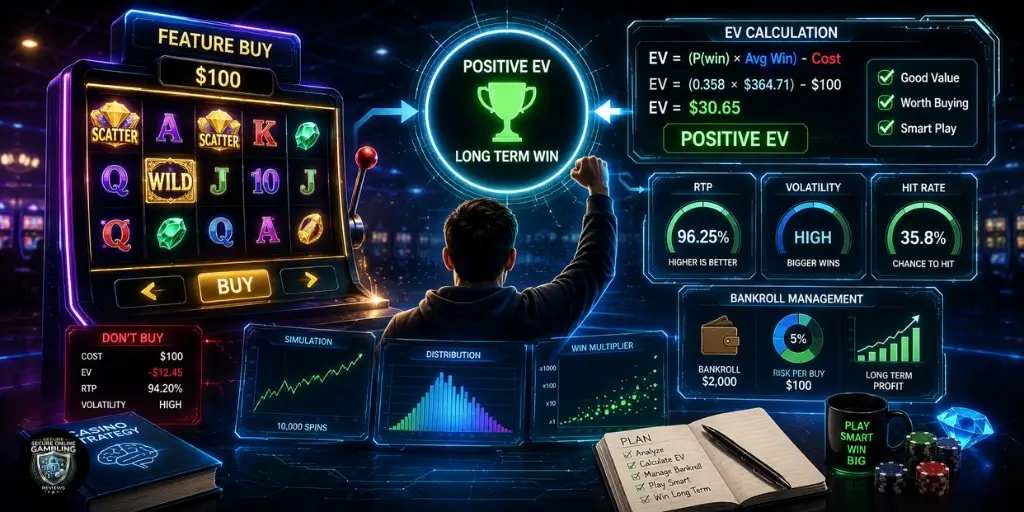
To make informed, strategic decisions rather than just relying on blind luck, players need to grasp the concept of slot machine ev (Expected Value). By looking past the flashing lights and understanding the hidden mechanics of expected value, you can elevate your gaming approach from casual spinning to calculated entertainment.
- What Exactly is Expected Value in Slots?
- The Mechanics and Appeal of Buy Feature Slots
- Deep Dive: Slot Feature Buy EV Calculation
- Volatility and Variance: The Hidden Forces
- Finding the Edge: Advanced Slot Strategies
- Leveraging Casino Bonuses to Shift EV
- Actionable Tips for the Smart Slot Player
- The Bottom Line
- slot feature buy ev calculation
- What Exactly is Expected Value in Slots?
- The Mechanics and Appeal of Buy Feature Slots
- Deep Dive: Slot Feature Buy EV Calculation
- Volatility and Variance: The Hidden Forces
- Finding the Edge: Advanced Slot Strategies
- Leveraging Casino Bonuses to Shift EV
- Actionable Tips for the Smart Slot Player
- The Bottom Line
What Exactly is Expected Value in Slots?
Before we can dive into complex formulas and bonus round valuations, it is crucial to establish the foundational math behind every single spin. Expected Value (EV) represents the mathematical average of what a player can expect to win or lose per bet over an infinite number of spins.
To master EV, you must start by understanding return to player percentages (RTP). RTP is the theoretical percentage of all wagered money that a slot will pay back to players over time. For instance, if a game has a 96% RTP, it theoretically returns $96 for every $100 wagered.
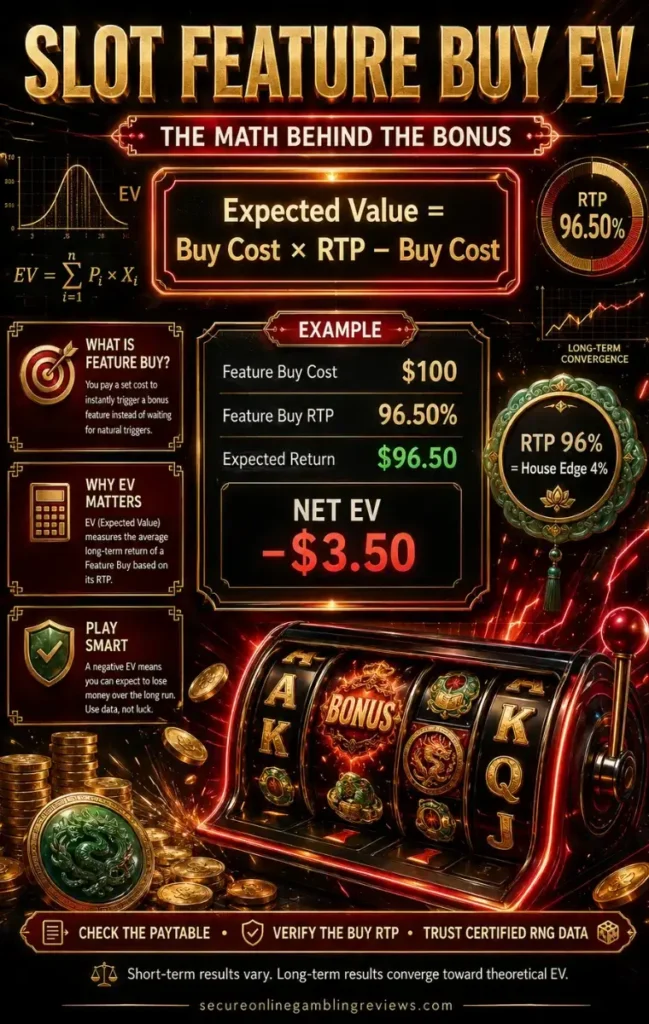
The remaining percentage belongs to the casino. For players wondering how to calculate casino house edge, the formula is incredibly straightforward: subtract the game’s RTP from 100%. In a game with a 96% RTP, the house edge is exactly 4%. This 4% is the mathematical advantage the casino holds on every wager made, ensuring their long-term profitability.
The Mechanics and Appeal of Buy Feature Slots
In recent years, buy feature slots have revolutionized the casino industry. These games allow you to pay a premium—typically ranging anywhere from 50x to over 200x your base stake—to instantly trigger the game’s free spins or specialized bonus round. The appeal is undeniably strong: you get instant gratification and immediate access to the game’s highest payout potential without the tedious grind of base game spins.
However, purchasing a bonus drastically alters your immediate risk profile. While you are guaranteed to see the feature, you are paying a massive premium for it. Because you are risking a much larger amount of capital in a single event, performing a proper slot feature buy ev calculation becomes an absolute necessity for anyone looking to protect their gambling funds.
Deep Dive: Slot Feature Buy EV Calculation
How do you determine if purchasing a bonus round is a mathematically sound decision? While you can never guarantee a winning session, you can calculate the theoretical financial expectation of the bonus buy.
When you purchase a feature, the RTP sometimes shifts. Many modern video slots will offer a standard 96.00% RTP in the base game, but that figure might increase slightly to 96.50% when you choose to buy the bonus feature.
Here is a step-by-step example of a slot feature buy ev calculation:
- Cost of the Feature Buy: $100
- Published Feature Buy RTP: 96.50%
- Calculation: Multiply the cost of the buy by the RTP percentage ($100 x 0.965 = $96.50).
- Net Expected Value: -$3.50
In this scenario, your EV is negative $3.50. Statistically speaking, you will lose $3.50 every time you buy this specific feature over a mathematically infinite timeline.
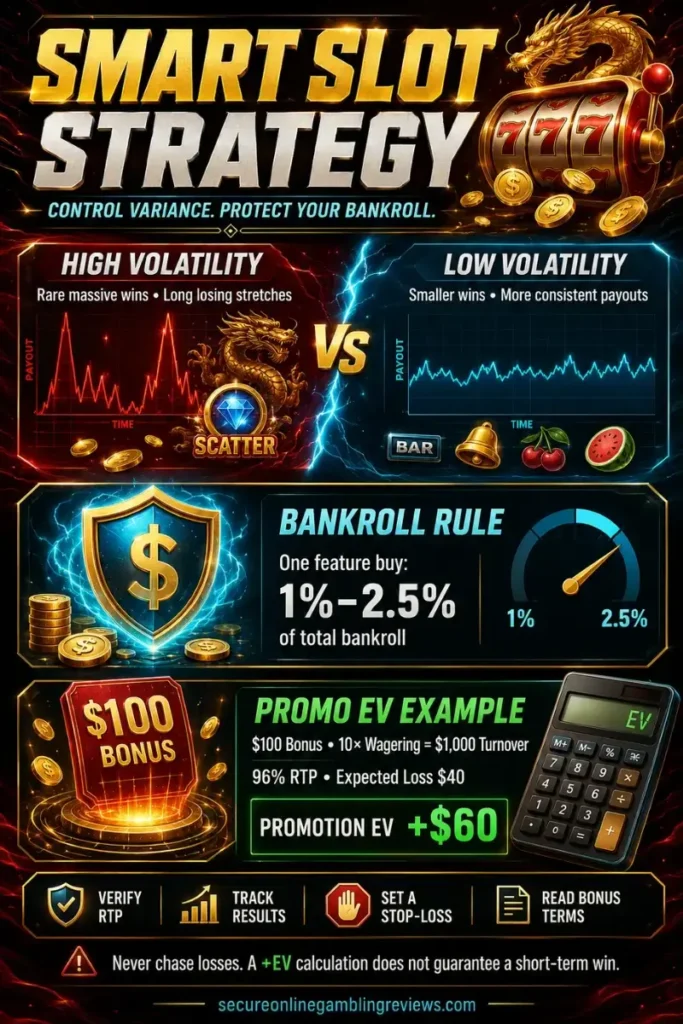
Recognizing the vast difference between theoretical vs actual payout rates is vital here. In a single evening of playing, you might buy a $100 feature and win $2,000, or you might win $0. The actual payout in the short term is wildly unpredictable. However, over millions of simulated bonus buys, the actual payout rate will eventually converge to perfectly match the theoretical EV.
Relying on Verified Data
To make accurate calculations, you must base your math on empirical facts. This starts with knowing exactly how to read slot machine paytables. The paytable does more than just show you what five cherry symbols pay; in modern games, it provides detailed rules, mechanics, and explicitly states the RTP for both the base game and the feature buy option.
Furthermore, you must ensure you are playing on legitimate platforms. Always verify that a casino adheres to strict Random Number Generator certification standards (such as audits by eCOGRA or iTech Labs). These certifications guarantee that the game’s outcomes are truly random, the deck is not stacked against you, and the published RTP data required for your EV calculations is 100% legitimate.
Volatility and Variance: The Hidden Forces
While Expected Value tells you what the math dictates over millions of spins, volatility dictates what happens to your money today. The impact of volatility on gambling bankroll cannot be overstated, particularly when you are buying expensive bonus features.
Understanding the crucial differences between high volatility vs low volatility games is the key to survival. A highly volatile slot might boast the exact same 96% RTP as a low volatility game, but it distributes its payouts in a drastically different manner. High volatility games offer the chance for monumental multipliers and massive jackpots, but they offset these rare events with long stretches of dead spins or bonus rounds that pay next to nothing. Conversely, low volatility games offer smaller, more consistent payouts to keep your balance steady.
When you buy a feature on a high volatility game, you might experience five or six “dead” bonuses in a row before hitting a colossal win. Therefore, managing long-term statistical variance requires stringent discipline and a bankroll large enough to absorb violent downswings without going bankrupt.
Finding the Edge: Advanced Slot Strategies
Generally speaking, slots are strictly negative expectation games designed to make the casino money. However, mathematically inclined players are constantly looking for ways to flip the script, actively identifying positive expectation betting opportunities (+EV).
Advantage Play in Slots
While it is increasingly rare in modern digital environments, advantage play slot strategies do exist. These strategies usually revolve around specific game mechanics, such as “Must Hit By” progressives (where a jackpot is guaranteed to trigger before a specific monetary value) or accumulator games where players collect tokens or wild symbols over time. By observing these machines and only stepping in to play when the game is mathematically primed to pay out soon, a disciplined advantage player can actually achieve a positive Expected Value.
Progressive Jackpot Mathematics
Another rare avenue to find a +EV situation is through a progressive jackpot break-even point analysis. Because a progressive jackpot takes a tiny fraction of every bet and adds it to a central prize pool, the jackpot continuously grows. As the top prize swells, the game’s overall effective RTP rises along with it.
Eventually, a progressive jackpot can reach a mathematical “break-even point” where the RTP temporarily exceeds 100%. Playing the game at or above this precise threshold makes the wager mathematically +EV. However, players must remain grounded and accept that the probability of hitting a jackpot cycle remains astronomically low. You may be making a mathematically correct bet, but variance means you are still highly likely to lose your base spins while chasing the top prize.
Leveraging Casino Bonuses to Shift EV
One of the most effective and popular ways to offset the inherent casino house edge—and make your overall EV favorable—is through the strategic use of casino promotional funds. By utilizing deposit matches, cashback offers, or free spins, you can sometimes artificially inflate your bankroll and turn a mathematically negative EV game into a highly profitable endeavor.
Hunting down mathematically beatable casino bonuses requires careful scrutiny of the promotional terms and conditions. The absolute most critical step in this process is evaluating casino bonus wagering requirements.
Consider this mathematical breakdown:
- A casino offers you a $100 bonus with a 10x wagering requirement. This means you must place $1,000 worth of bets before you can withdraw the bonus funds as cash.
- You choose to wager this money on a slot with a 96% RTP (a 4% house edge).
- Your expected theoretical loss during the wagering process is $40 ($1,000 x 0.04).
- Since your initial bonus was $100 and your expected loss is $40, your mathematical Expected Value for this promotion is +$60.
By understanding this math, you can systematically hunt for bonuses that offer a positive return. A word of caution: Many online casinos actively protect themselves against this by explicitly banning bonus buys with active promotional funds, or by lowering the wagering contribution percentages on high RTP games. Always read the fine print before deploying this strategy.
Actionable Tips for the Smart Slot Player
To protect your hard-earned bankroll and make the smartest possible decisions on the casino floor, consider implementing these practical guidelines into your regular play:
- Implement Smart Bet Sizing: Focus heavily on optimizing betting patterns for maximum returns. If you are sitting with a $500 bankroll, blindly purchasing $100 bonus features will likely lead to a very short gaming session. Scale your feature buys appropriately. A good rule of thumb is that a single feature buy should represent no more than 1% to 2.5% of your total bankroll. This sizing ensures you can survive the inevitable variance of highly volatile games.
- Always Verify the Buy RTP: Never blindly assume that the feature buy RTP is higher than the base game RTP. While it often is, some game developers actually lower the RTP for feature buys. Always verify the exact numbers in the game’s information panel before clicking the buy button.
- Track Your Results: Keep a meticulous log of your feature buy costs versus your actual returns. This data helps ground you in reality when you hit an emotional winning or losing streak, clearly highlighting the natural gap between short-term results and long-term mathematical EV.
- Set Strict Stop-Loss Limits: EV calculations apply perfectly over an infinite long run, but in the short run, you can lose significantly. Don’t fall into the gambler’s fallacy of chasing losses in an attempt to eventually hit your “expected” statistical average. Know exactly when to walk away.
The Bottom Line
Navigating the thrilling, high-stakes world of feature buys doesn’t have to be a shot in the dark. By understanding the core principles of expected value, RTP, and house edge, you transition from being a passive gambler into a highly informed strategist.
While no amount of calculation can alter the fundamentally random nature of an RNG-certified slot machine on a spin-by-spin basis, mastering the underlying math empowers you. It allows you to manage your bankroll with precision, minimize your expected losses, and instantly spot those rare, exciting moments when the mathematical odds actually tip slightly in your favor. Play smart, respect the volatile nature of the games, and let the math guide your entertainment.
slot feature buy ev calculation
Welcome to the modern era of casino gaming, where waiting patiently for three scatter symbols to land on the reels is no longer a strict requirement. With the rapid evolution of online and land-based gaming, players can now skip the repetitive base game and jump straight into the most thrilling part of a slot: the bonus round. But at what cost? Whenever you bypass the base game by paying a premium, mathematics takes center stage.
To make informed, strategic decisions rather than just relying on blind luck, players need to grasp the concept of slot machine ev (Expected Value). By looking past the flashing lights and understanding the hidden mechanics of expected value, you can elevate your gaming approach from casual spinning to calculated entertainment.
What Exactly is Expected Value in Slots?
Before we can dive into complex formulas and bonus round valuations, it is crucial to establish the foundational math behind every single spin. Expected Value (EV) represents the mathematical average of what a player can expect to win or lose per bet over an infinite number of spins.
To master EV, you must start by understanding return to player percentages (RTP). RTP is the theoretical percentage of all wagered money that a slot will pay back to players over time. For instance, if a game has a 96% RTP, it theoretically returns $96 for every $100 wagered.
The remaining percentage belongs to the casino. For players wondering how to calculate casino house edge, the formula is incredibly straightforward: subtract the game’s RTP from 100%. In a game with a 96% RTP, the house edge is exactly 4%. This 4% is the mathematical advantage the casino holds on every wager made, ensuring their long-term profitability.
The Mechanics and Appeal of Buy Feature Slots
In recent years, buy feature slots have revolutionized the casino industry. These games allow you to pay a premium—typically ranging anywhere from 50x to over 200x your base stake—to instantly trigger the game’s free spins or specialized bonus round. The appeal is undeniably strong: you get instant gratification and immediate access to the game’s highest payout potential without the tedious grind of base game spins.
However, purchasing a bonus drastically alters your immediate risk profile. While you are guaranteed to see the feature, you are paying a massive premium for it. Because you are risking a much larger amount of capital in a single event, performing a proper slot feature buy ev calculation becomes an absolute necessity for anyone looking to protect their gambling funds.
Deep Dive: Slot Feature Buy EV Calculation
How do you determine if purchasing a bonus round is a mathematically sound decision? While you can never guarantee a winning session, you can calculate the theoretical financial expectation of the bonus buy.
When you purchase a feature, the RTP sometimes shifts. Many modern video slots will offer a standard 96.00% RTP in the base game, but that figure might increase slightly to 96.50% when you choose to buy the bonus feature.
Here is a step-by-step example of a slot feature buy ev calculation:
- Cost of the Feature Buy: $100
- Published Feature Buy RTP: 96.50%
- Calculation: Multiply the cost of the buy by the RTP percentage ($100 x 0.965 = $96.50).
- Net Expected Value: -$3.50
In this scenario, your EV is negative $3.50. Statistically speaking, you will lose $3.50 every time you buy this specific feature over a mathematically infinite timeline.
Recognizing the vast difference between theoretical vs actual payout rates is vital here. In a single evening of playing, you might buy a $100 feature and win $2,000, or you might win $0. The actual payout in the short term is wildly unpredictable. However, over millions of simulated bonus buys, the actual payout rate will eventually converge to perfectly match the theoretical EV.
Relying on Verified Data
To make accurate calculations, you must base your math on empirical facts. This starts with knowing exactly how to read slot machine paytables. The paytable does more than just show you what five cherry symbols pay; in modern games, it provides detailed rules, mechanics, and explicitly states the RTP for both the base game and the feature buy option.
Furthermore, you must ensure you are playing on legitimate platforms. Always verify that a casino adheres to strict Random Number Generator certification standards (such as audits by eCOGRA or iTech Labs). These certifications guarantee that the game’s outcomes are truly random, the deck is not stacked against you, and the published RTP data required for your EV calculations is 100% legitimate.
Volatility and Variance: The Hidden Forces
While Expected Value tells you what the math dictates over millions of spins, volatility dictates what happens to your money today. The impact of volatility on gambling bankroll cannot be overstated, particularly when you are buying expensive bonus features.
Understanding the crucial differences between high volatility vs low volatility games is the key to survival. A highly volatile slot might boast the exact same 96% RTP as a low volatility game, but it distributes its payouts in a drastically different manner. High volatility games offer the chance for monumental multipliers and massive jackpots, but they offset these rare events with long stretches of dead spins or bonus rounds that pay next to nothing. Conversely, low volatility games offer smaller, more consistent payouts to keep your balance steady.
When you buy a feature on a high volatility game, you might experience five or six “dead” bonuses in a row before hitting a colossal win. Therefore, managing long-term statistical variance requires stringent discipline and a bankroll large enough to absorb violent downswings without going bankrupt.
Finding the Edge: Advanced Slot Strategies
Generally speaking, slots are strictly negative expectation games designed to make the casino money. However, mathematically inclined players are constantly looking for ways to flip the script, actively identifying positive expectation betting opportunities (+EV).
Advantage Play in Slots
While it is increasingly rare in modern digital environments, advantage play slot strategies do exist. These strategies usually revolve around specific game mechanics, such as “Must Hit By” progressives (where a jackpot is guaranteed to trigger before a specific monetary value) or accumulator games where players collect tokens or wild symbols over time. By observing these machines and only stepping in to play when the game is mathematically primed to pay out soon, a disciplined advantage player can actually achieve a positive Expected Value.
Progressive Jackpot Mathematics
Another rare avenue to find a +EV situation is through a progressive jackpot break-even point analysis. Because a progressive jackpot takes a tiny fraction of every bet and adds it to a central prize pool, the jackpot continuously grows. As the top prize swells, the game’s overall effective RTP rises along with it.
Eventually, a progressive jackpot can reach a mathematical “break-even point” where the RTP temporarily exceeds 100%. Playing the game at or above this precise threshold makes the wager mathematically +EV. However, players must remain grounded and accept that the probability of hitting a jackpot cycle remains astronomically low. You may be making a mathematically correct bet, but variance means you are still highly likely to lose your base spins while chasing the top prize.
Leveraging Casino Bonuses to Shift EV
One of the most effective and popular ways to offset the inherent casino house edge—and make your overall EV favorable—is through the strategic use of casino promotional funds. By utilizing deposit matches, cashback offers, or free spins, you can sometimes artificially inflate your bankroll and turn a mathematically negative EV game into a highly profitable endeavor.
Hunting down mathematically beatable casino bonuses requires careful scrutiny of the promotional terms and conditions. The absolute most critical step in this process is evaluating casino bonus wagering requirements.
Consider this mathematical breakdown:
- A casino offers you a $100 bonus with a 10x wagering requirement. This means you must place $1,000 worth of bets before you can withdraw the bonus funds as cash.
- You choose to wager this money on a slot with a 96% RTP (a 4% house edge).
- Your expected theoretical loss during the wagering process is $40 ($1,000 x 0.04).
- Since your initial bonus was $100 and your expected loss is $40, your mathematical Expected Value for this promotion is +$60.
By understanding this math, you can systematically hunt for bonuses that offer a positive return. A word of caution: Many online casinos actively protect themselves against this by explicitly banning bonus buys with active promotional funds, or by lowering the wagering contribution percentages on high RTP games. Always read the fine print before deploying this strategy.
To maximize your initial bankroll and minimize variance, leverage the exclusive W88 Promotion tailored specifically for slot enthusiasts. New members can claim a 100% deposit match up to $200, instantly doubling their starting capital to weather high-volatility cycles, alongside daily high-roller rebates offering up to 1% cash back on all spin volume.
Actionable Tips for the Smart Slot Player
To protect your hard-earned bankroll and make the smartest possible decisions on the casino floor, consider implementing these practical guidelines into your regular play:
- Implement Smart Bet Sizing: Focus heavily on optimizing betting patterns for maximum returns. If you are sitting with a $500 bankroll, blindly purchasing $100 bonus features will likely lead to a very short gaming session. Scale your feature buys appropriately. A good rule of thumb is that a single feature buy should represent no more than 1% to 2.5% of your total bankroll. This sizing ensures you can survive the inevitable variance of highly volatile games.
- Always Verify the Buy RTP: Never blindly assume that the feature buy RTP is higher than the base game RTP. While it often is, some game developers actually lower the RTP for feature buys. Always verify the exact numbers in the game’s information panel before clicking the buy button.
- Track Your Results: Keep a meticulous log of your feature buy costs versus your actual returns. This data helps ground you in reality when you hit an emotional winning or losing streak, clearly highlighting the natural gap between short-term results and long-term mathematical EV.
- Set Strict Stop-Loss Limits: EV calculations apply perfectly over an infinite long run, but in the short run, you can lose significantly. Don’t fall into the gambler’s fallacy of chasing losses in an attempt to eventually hit your “expected” statistical average. Know exactly when to walk away.
The Bottom Line
Navigating the thrilling, high-stakes world of feature buys doesn’t have to be a shot in the dark. By understanding the core principles of expected value, RTP, and house edge, you transition from being a passive gambler into a highly informed strategist.
While no amount of calculation can alter the fundamentally random nature of an RNG-certified slot machine on a spin-by-spin basis, mastering the underlying math empowers you. It allows you to manage your bankroll with precision, minimize your expected losses, and instantly spot those rare, exciting moments when the mathematical odds actually tip slightly in your favor. Play smart, respect the volatile nature of the games, and let the math guide your entertainment.
To maximize your edge, explore our data-driven online gambling reviews for the most reliable platforms. Above all, always protect your bankroll and play safely by reviewing our Responsible Gambling Policy.